Month-end close has a familiar rhythm: find the records, reconcile the differences, calculate the adjustments, and prepare the entries. It takes training, concentration, and time. A new Mercor study suggests AI can already perform some of that work exceptionally well.
The important question is how businesses can reorganize their work, processes, and data so more tasks meet those conditions. That is an organizational challenge as well as a technical one.
Same files. Same rules. Different results.
Mercor recruited 12 practicing U.S. CPAs and gave them four simulated month-end assignments: nonprofit budget variances, hotel revenue reconciliation, event revenue analysis, and lease accounting. Each participant completed two tasks alone and two with Claude, with a three-hour window per task. AI separately tackled the same assignments using the same files and grading criteria.
Unassisted accountants satisfied about 37% of the grading criteria on average. The Claude model used in the study achieved 100% and finished much faster. Accountants using Claude also performed substantially better, but took about 15 times longer than Claude alone.
These were experienced participants: they averaged 5.4 years in accounting, and most were seniors or managers, despite the headline’s description of them as junior accountants.
Why humans fell behind
The assignments demanded a difficult combination: discover every relevant fact across unfamiliar files, follow every company-specific rule, and carry each adjustment through all affected calculations.
One hotel task included December stays that were not billed until January. Another company required monthly lease reclassification, a step nearly every unassisted participant missed. A single overlooked detail could affect the reconciliation, journal entry, and final income calculation.
Humans sometimes settled on a plausible approach and continued without checking every exception. AI excelled at searching the file set and following the instructions closely. In this setting, meticulousness had a measurable advantage.
The three conditions that matter
- The facts are available. The evidence needed to reach the answer exists in the supplied records.
- The rules are explicit. The task specifies the accounting treatment and relevant company policies.
- The output is verifiable. Someone can check the result against those records and rules.
Verifiable does not mean automatically correct. If AI proposes a revenue adjustment, you can trace the transaction, confirm the amount, check the period, and inspect the entry. That is a different proposition from asking AI for the best business strategy, where the answer depends on uncertain future outcomes.
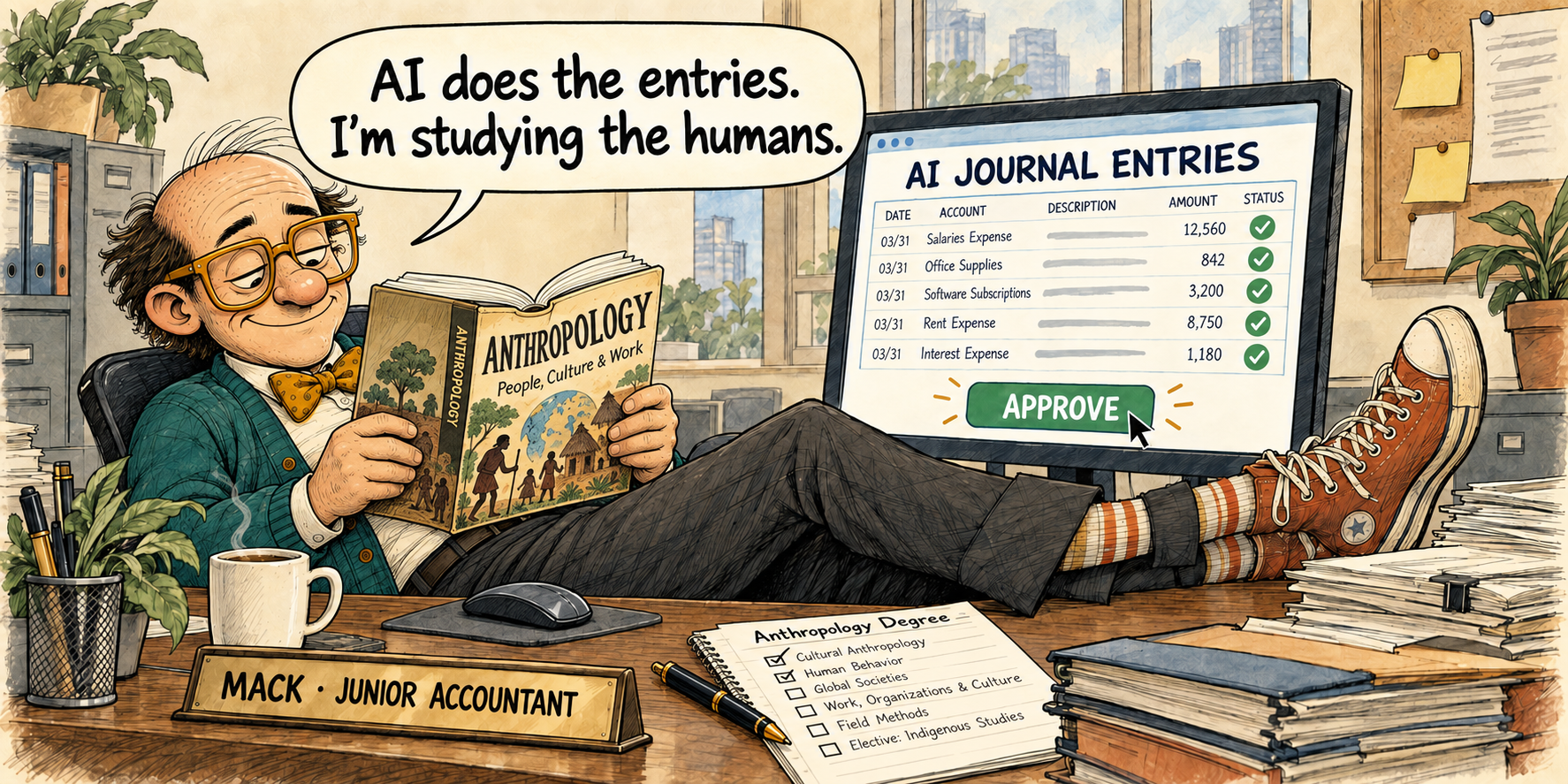
Mack still has a job. It may be a different one.
The study does not establish that accounting is solved. It involved four assignments and 12 people, without colleagues to consult or the company familiarity accountants build over time. The benchmark also packed in unusually dense exceptions. Its rubric measured specified answers, not the full value of professional judgment.
It also does not prove human review is wasted time. Once AI scores 100%, the rubric cannot reward further improvement. In an actual business, review can still establish whether the inputs are complete, the policy is appropriate, and the result makes sense.
But the direction is consequential. If AI can prepare defined work quickly, accountants may spend more time obtaining missing facts, investigating anomalies, choosing defensible treatments, and explaining what the numbers mean. Clicking “approve” is easy. Knowing what deserves approval remains valuable.
Reorganize the work to unlock the value
The practical implication is to make more work suitable for reliable AI execution. That means connecting transactions to supporting documents, capturing explanations that currently sit in emails, documenting company-specific rules, and defining how exceptions move to a person.
Consider a partial shipment. An invoice may depend on an explanation from Customer Service that never appears in the shipping records. Faster calculations cannot supply a missing instruction. Capturing shipment status and invoicing scope consistently could make the task easier to delegate and verify.
Businesses also need checks that travel with the output: source references, reconciliations, approval responsibilities, and escalation when records conflict. A prepared research rubric is not something every finance department already has. Verification has a cost, and the relevant productivity measure is the whole process—including preparation, review, corrections, and implementation.
Some decisions resist being reduced to explicit rules. The goal is to identify the parts that can be delegated economically while preserving a route for ambiguity and judgment.
Could anthropology be an asset?
That raises an intriguing possibility: people with an applied anthropology or ethnography background could be valuable members of AI implementation teams. Ethnography studies people in context through observation and interviews. It can help reveal how work actually happens: informal handoffs, unwritten knowledge, workarounds, and reasons employees trust or bypass a system.
There is a practical precedent. An EPIC case study of a factory data platform describes using ethnographic and participatory methods to bring operators’ practical knowledge into system design. That supports the usefulness of the method; it does not establish that anthropology graduates will deliver higher AI returns.
My hypothesis is that combining these skills with accounting, process design, and data engineering could help organizations uncover what must change before work can be offloaded reliably. The skill matters more than the degree label: experienced employees, business analysts, and organizational researchers can contribute similar insights. Anthropology could be a useful tool in the toolbox, alongside domain expertise, process design, and data engineering.
Nor does automation guarantee spare time or a safe new career path. Management may increase workload, reduce staffing, or invest the capacity elsewhere. And if junior accountants stop preparing entries entirely, firms need another way to develop the expertise required to review them. Mack’s anthropology textbook illustrates adding a tool to his toolbox: understanding the people and context behind the numbers.
The Bite-Sized Take
When the facts are available, the rules are explicit, and the output is verifiable, AI can already solve some complex accounting tasks exceptionally well. The next opportunity is to reorganize work, processes, and data so more tasks meet those conditions.
Understanding the people doing the work could be an important part of that redesign. Applied anthropology may help expose the context that a process chart misses; domain expertise and engineering must turn those insights into a dependable operating process.
The Mercor study demonstrates task performance. The argument for redesigning work—and for bringing anthropology into that effort—is an implication worth exploring, not a finding the study tested. The payoff must ultimately show up in better outcomes after the full cost of change.