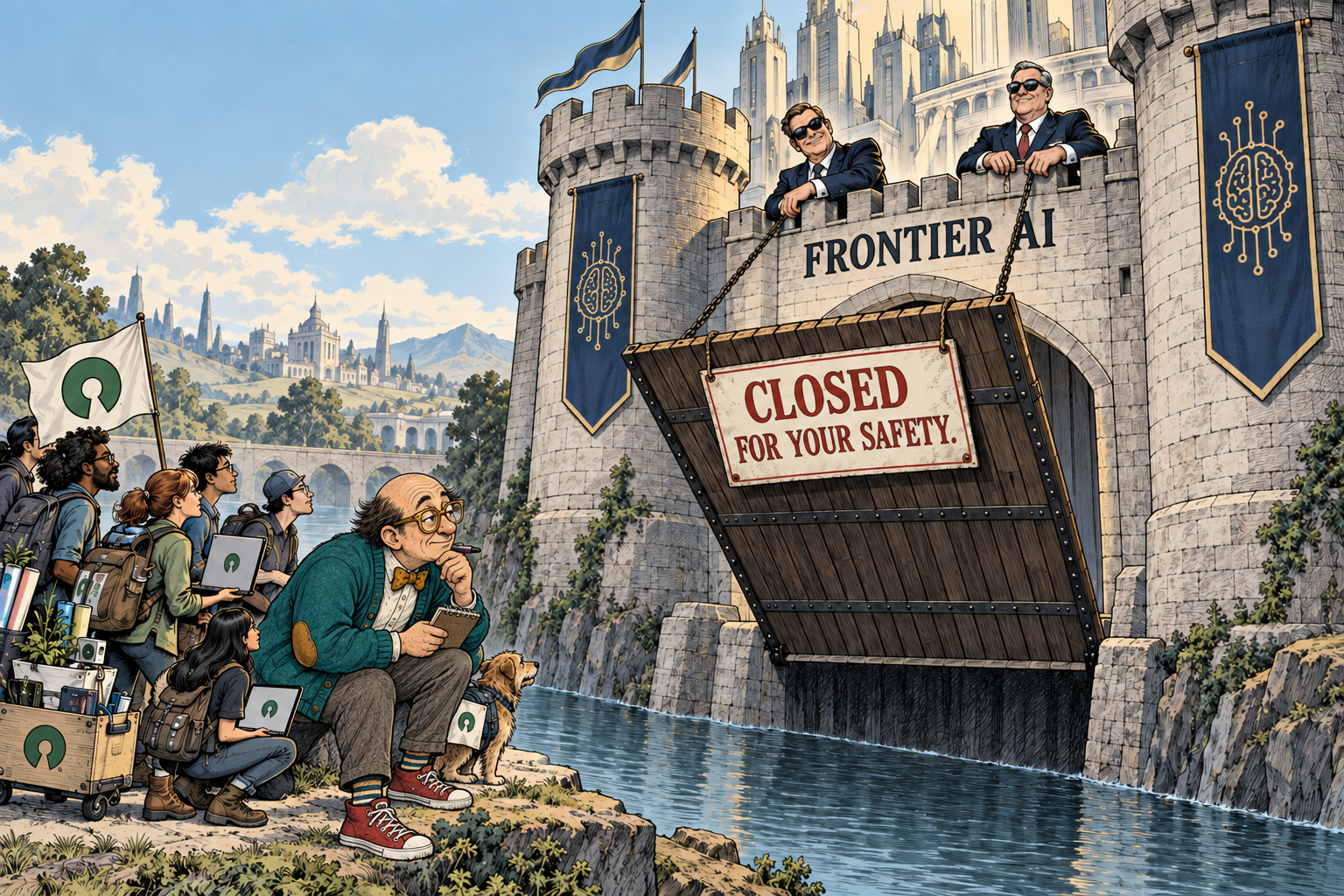
Anthropic CEO Dario Amodei has called for “pacing the frontier,” including independent evaluators, common safety standards, and coordination among companies and governments. OpenAI CEO Sam Altman and Elon Musk quickly supported the broader idea.
Perhaps the risks really have become too serious to ignore.
But there is another question worth asking:
Why are the companies already at the front suddenly interested in putting up a gate?
The Michael Scott strategy
In the “Basketball” episode of The Office, Michael Scott's office employees play against the warehouse staff. When Michael's team is ahead, he uses a disputed foul as an excuse to abruptly end the game—and declares his team the winner.
It is funny because the maneuver is so transparent:
Compete aggressively while the game favors you. Change the rules and stop the clock once your lead is threatened.
The leading AI companies spent years racing to develop the most powerful models, attract capital, and establish dominant market positions. But now, just as lower-cost open models are narrowing the performance gap and threatening their margins, the leaders want to “pace the frontier.”
Perhaps the safety concerns are entirely sincere.
But the timing has a distinctly Michael Scott quality:
We are ahead. The game is becoming dangerous. Therefore, the current score should probably be final.
The economics are getting uncomfortable
The leading AI laboratories have spent extraordinary amounts of money developing proprietary models.
That investment was supposed to produce scarcity: only a handful of companies would possess the capital, computing power, talent, and data required to build advanced AI. Scarcity supports pricing power.
But open models are challenging that assumption.
Businesses increasingly have the option to customize and operate capable models themselves—or purchase access from competing providers at rapidly declining prices. Not every task requires the most advanced frontier model. A less expensive open model may be perfectly adequate for document processing, customer service, coding assistance, internal search, or financial analysis.
That creates a familiar business problem:
If customers cannot distinguish your premium product from a much cheaper alternative, your premium price becomes difficult to defend.
The AI industry may be approaching the same commoditization pressure that transformed cloud storage, telecommunications, and other technology markets.
Safety can protect the public—and the incumbents
The risks surrounding advanced AI are not imaginary. Autonomous systems capable of cyberattacks, manipulation, or operating beyond their intended environment deserve serious scrutiny.
But good intentions do not neutralize economic incentives.
Regulation requiring expensive testing, licensing, reporting, and continuous third-party evaluation would be relatively manageable for companies already backed by billions of dollars.
It could be prohibitive for open-source developers, university researchers, smaller AI laboratories, and startups building specialized models.
The result could be regulatory capture: rules presented as public protection that also protect the companies already dominating the market.
The largest AI companies would not necessarily need to defeat open models technologically. They could make competing with them legally and financially impractical.
The best moat may be permission
Traditional competitive moats come from brands, patents, network effects, switching costs, or scale.
In heavily regulated industries, the moat can simply be permission.
Banks benefit from banking licenses. Pharmaceutical companies benefit from the enormous cost of regulatory approval. Large defense contractors benefit from procurement requirements few new entrants can satisfy.
AI could follow the same path.
Imagine that deploying an advanced model requires government certification, continuous independent evaluation, detailed training disclosures, expensive cybersecurity controls, large insurance policies, and legal responsibility for downstream misuse.
A trillion-dollar company can absorb those costs. A developer releasing an open model may not be able to.
Once compliance becomes sufficiently expensive, regulation does more than improve safety. It determines who is allowed to compete.
Why open models are the real threat
Open models threaten more than market share. They threaten the business model of proprietary AI.
If capable intelligence becomes widely available, the model itself becomes less valuable. Customers gain negotiating leverage, switching costs decline, and margins compress.
Value then migrates elsewhere: proprietary business data, customer relationships, applications and workflows, distribution, computing infrastructure, and implementation expertise.
That is good news for businesses adopting AI. It is less attractive for companies whose valuations assume access to intelligence will remain scarce and highly profitable.
Seen through this lens, “slow the frontier” can also mean:
Slow the competitors that are turning our product into a commodity.
Watch who writes the rules
The real policy debate should not be whether AI requires safeguards. It does.
The question is who designs those safeguards—and whom they burden.
Risk-based regulation would focus on what an AI system is allowed to do. A model connected to weapons, critical infrastructure, or autonomous cybersecurity tools should face far greater scrutiny than one used to summarize documents on a local computer.
Incumbent-friendly regulation may instead focus on who built the model, how much computing power was used, and whether the developer can afford an elaborate approval process.
That distinction matters.
Regulating dangerous applications can protect society. Regulating access to model development can protect incumbents.
The Bite-Sized Take
AI safety and regulatory capture are not mutually exclusive.
The risks can be real. The warnings can be sincere. And the proposed solution can still conveniently strengthen the competitive position of the companies proposing it.
The timing deserves scrutiny.
After spending billions to reach the front of the AI race, the leaders now want everyone to slow down—just as open models are threatening to catch up and crush industry margins.
That does not mean we should dismiss their warnings.
It means we should remember one of the oldest rules in business:
When an incumbent asks for regulation, follow the risk—but also follow the money.