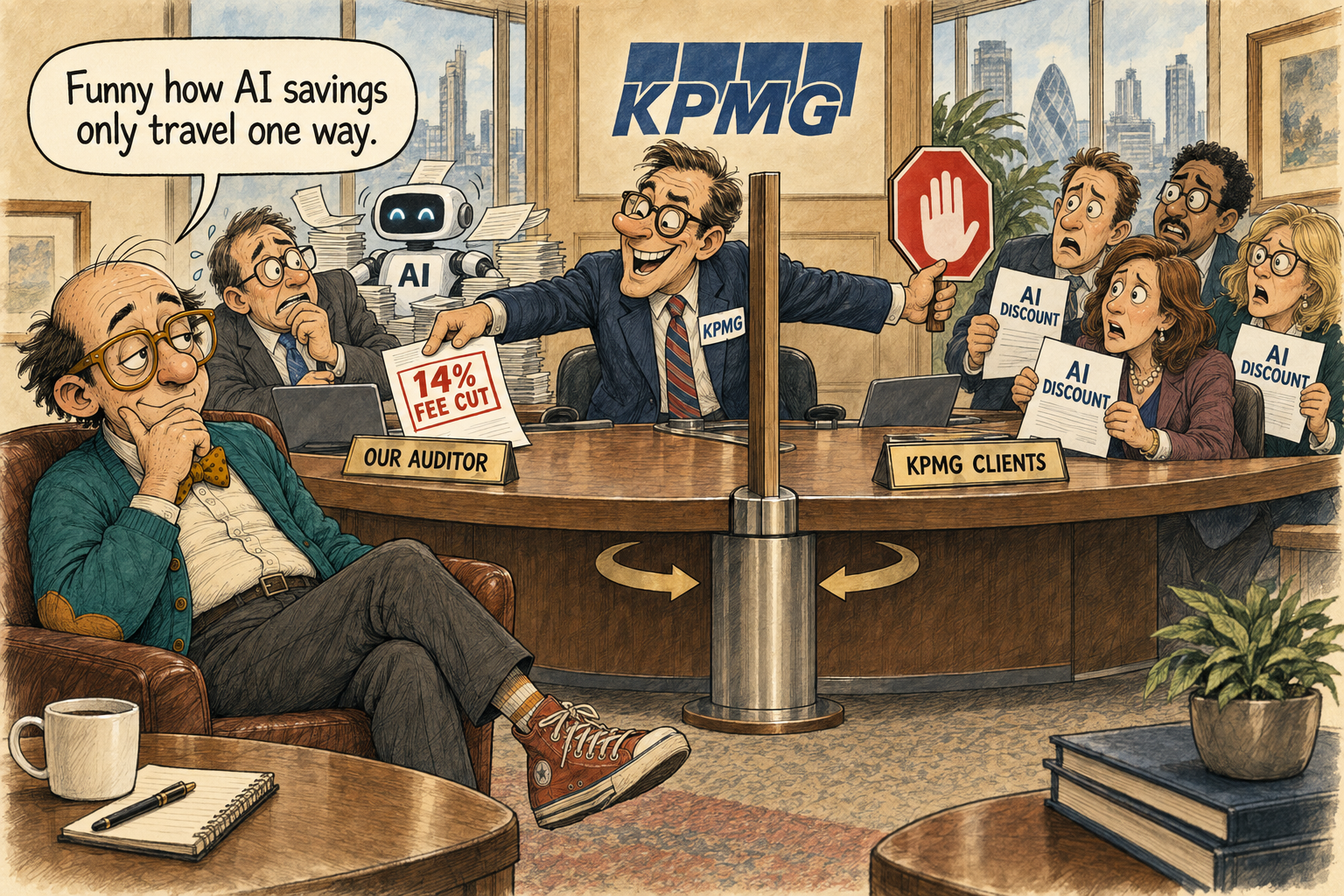
KPMG reportedly argued that AI and other technology should make the audit faster and less expensive. It also pointed out that Grant Thornton already knew the organization well and that KPMG International’s books were not particularly complicated.
The argument worked. KPMG’s audit fee declined from $416,000 in 2024 to $357,000 in 2025.
There is only one awkward question:
What happens when KPMG’s clients make the same argument?
AI savings apparently travel one way
KPMG’s public position is more nuanced than the one it reportedly used during its own fee negotiation.
The firm acknowledges that AI can create efficiencies, but it also argues that developing and operating AI systems costs money. More importantly, KPMG says the greatest benefit of AI may be better audit quality—not necessarily lower fees.
Both points are reasonable.
AI systems require investment. Audits still depend on experienced professionals exercising judgment. Faster work is not automatically better work, and nobody wants an auditor blindly accepting a machine-generated conclusion.
But that does not resolve the contradiction.
If AI makes professional work faster when KPMG is buying the service, it cannot suddenly become irrelevant when KPMG is selling it.
The real casualty is the billable hour
The larger story is not a 14% reduction in one audit fee. It is the growing weakness of hourly billing as a business model.
For decades, professional-services firms have priced much of their work around time. A project requiring 1,000 hours costs more than one requiring 500 hours. Clients may negotiate the hourly rate, but the basic assumption remains that effort is a reasonable proxy for value.
AI is breaking that connection.
If technology allows a firm to complete 1,000 hours of work in 600 hours, billing the client for the original effort becomes increasingly difficult to defend. The work may still be valuable, but the hours no longer explain that value.
This will not affect only audit firms. The same pressure is coming for lawyers, consultants, investment bankers, advertising agencies, software developers, and other businesses that sell knowledge by the hour.
AI does not have to replace the professional to disrupt the pricing model. It only has to reduce the amount of professional time required.
AI may not eliminate the expert. It could eliminate the expert’s ability to charge for every hour the work used to take.
Faster work does not mean worthless work
Clients should not assume that every minute saved belongs entirely to them.
The service provider selected the technology, paid for it, trained its employees, redesigned its processes, and accepted the risk of using it. If the firm produces better work, identifies risks earlier, or delivers results faster, that improvement has economic value.
The answer therefore cannot be simply to replace a $500 human hour with a $5 AI prompt and pass every dollar of savings to the customer.
But the opposite position is equally unsustainable. Providers cannot use AI to expand their margins while continuing to bill clients as though the work were still performed entirely by people working at the old speed.
The win-win is sharing the AI dividend
The most sustainable outcome is a win-win: AI creates a larger pool of economic value, and that value is shared between the service provider and the client.
KPMG should retain part of the benefit because it invested in the technology, redesigned its processes, and remains accountable for the work. The client should also benefit through lower fees, faster delivery, or improved service.
There is no universal formula for dividing those savings. Whether the client receives 20%, 50%, or 80% of the productivity gain will depend on competitive alternatives, bargaining leverage, contract structure, and the negotiating skills of both parties.
The important point is that the value cannot flow permanently in only one direction. If both parties share the productivity dividend, the provider earns a return on its AI investment while the client receives a tangible benefit from the efficiency it helped fund.
AI should make the economic pie larger. Negotiation will determine how that larger pie is divided.
From hours worked to value delivered
The likely destination is not universally lower prices. It is different pricing.
Professional-services firms will increasingly have to charge for outcomes, complexity, risk, access to expertise, and accountability—not merely the number of hours recorded on a timesheet.
That could mean more fixed-fee arrangements, subscriptions, success fees, shared-savings models, or pricing tied to clearly defined deliverables. Routine work should become less expensive, while high-stakes judgment may continue to command a premium.
For CFOs, the negotiation should move beyond asking, “How many hours will this require?”
The better questions are:
- Which parts of the work are now automated?
- How has that changed the staffing model?
- What measurable improvement will the technology produce?
- Who receives the benefit when the work takes less time than expected?
- What am I paying for: effort, expertise, risk transfer, or results?
KPMG has demonstrated that these are fair questions to ask.
Its own clients should take note.
When technology makes time cheaper, value must find a new unit of measurement.