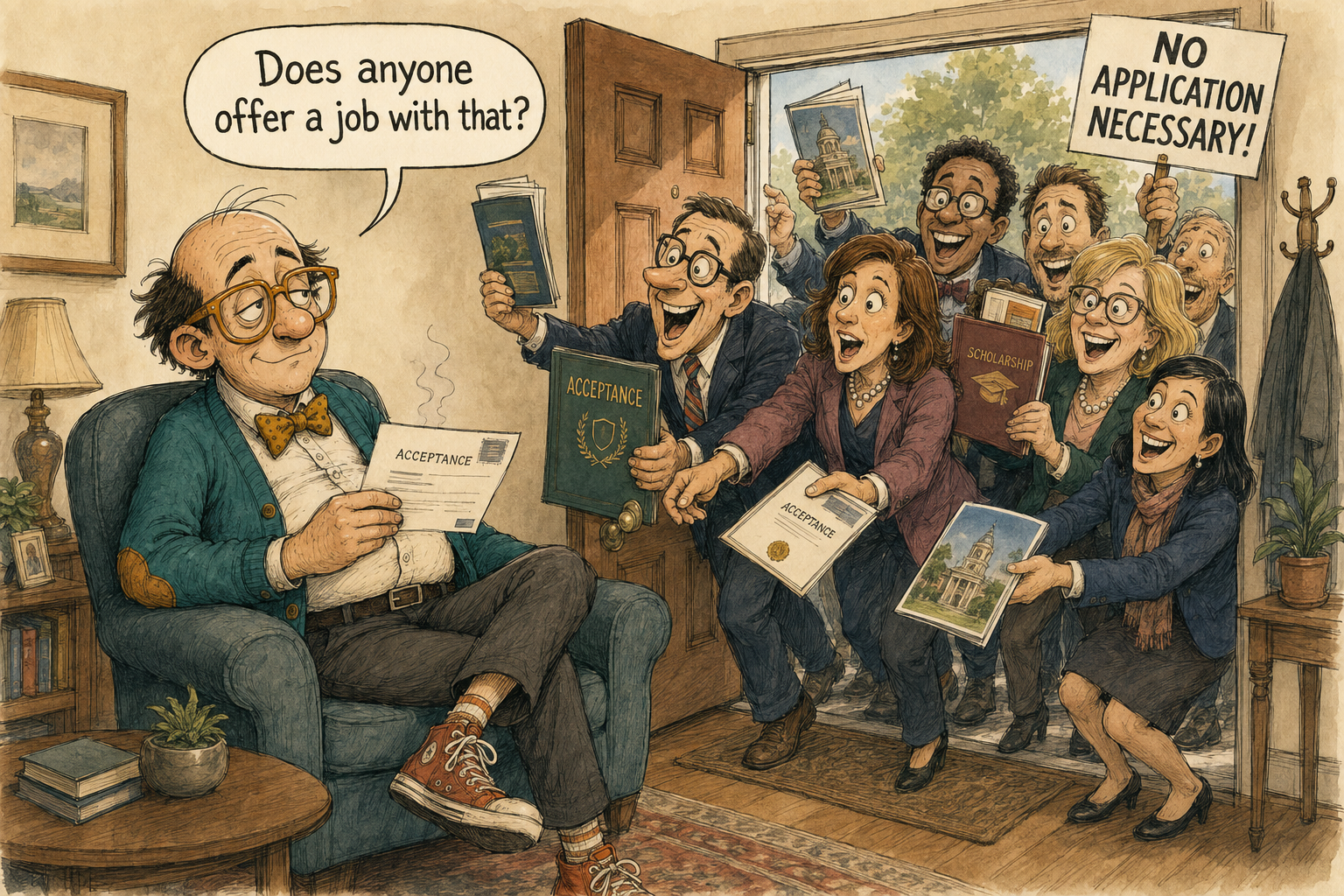
The Wall Street Journal reports that hundreds of colleges are admitting students who never applied. That sounds like an admissions story. It is really a supply-and-demand story.
For decades, colleges held the scarce asset: a seat. Students competed for admission, wrote essays, paid application fees, collected recommendations, and waited to learn whether they had made the cut.
Now the market is reversing. The seats still exist, but the students are becoming scarce. When acceptance letters arrive before applications, the gatekeeper has become the salesperson.
The demand curve is shifting
Demand is weakening from several directions at once. The traditional college-age population is shrinking as the demographic effects of lower birthrates reach campuses. International enrollment faces greater immigration and policy uncertainty. At the same time, families are questioning whether four years of tuition—and often substantial debt—still produces an adequate return.
There is also more competition for the student. Vocational programs, trade schools, apprenticeships, employer training, and other job-focused pathways offer a clearer and often less expensive route from education to a paycheck.
The demand for education has not disappeared. It is moving toward options that make the return easier to see.
Removing friction does not create value
Direct admission is a rational response. It removes essays, tests, fees, and uncertainty for qualified students. It can open doors for people who might otherwise assume that college is out of reach.
But removing the application does not fix the underlying economics. A simpler sales process cannot compensate indefinitely for a product customers increasingly see as too expensive, too slow, or too disconnected from employment.
Colleges will have to compete more directly on price, outcomes, flexibility, and relevance. Some will adapt by becoming more career-focused, building employer partnerships, offering shorter credentials, and making the financial return transparent. Others will keep marketing the old product harder.
Higher education meets the market
This is what supply and demand looks like when it reaches an institution accustomed to prestige and scarcity. Excess capacity does not care about tradition. If demand falls while supply remains fixed, prices, practices, or providers eventually have to change.
The unsolicited acceptance letter is therefore more than a clever recruiting tactic. It is a market signal. Colleges used to ask, “Why should we admit you?” Increasingly, students and families are asking the more consequential question: “Why should we choose you?”
The application may be disappearing. The burden of proving value is not.