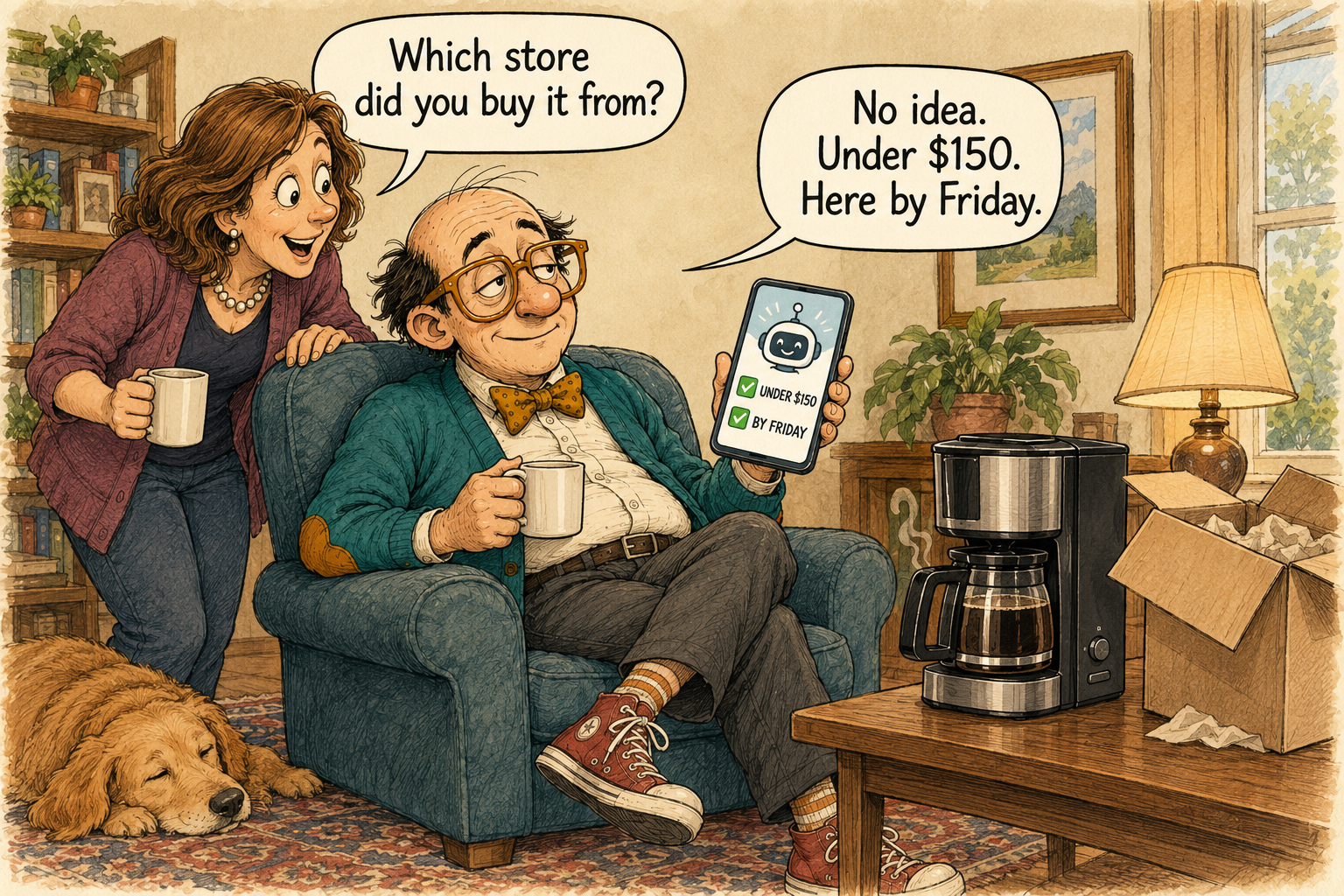
“Which store did you buy it from?”
“No idea. Under $150. Here by Friday.”
Online sellers have spent years perfecting the storefront: better photography, clearer descriptions, faster checkout. The goal is to turn a visitor into a buyer.
AI agents introduce a different possibility. The buyer tells an assistant what they need, and the assistant finds the product, compares offers and places the order. The customer may never visit the seller’s website.
Call it headless shopping: the store still processes the sale, but its pages no longer host the shopping experience.
That could change what it takes to win online.
From persuading a shopper to satisfying a request
A website gives a merchant room to make its case. Design builds credibility. Product placement guides attention. Bundles and recommendations encourage a larger purchase.
An agent could bypass much of that experience. Given “find a quiet dishwasher under $700, installed next week,” it needs dependable answers about specifications, availability, total cost and installation.
The seller’s carefully designed homepage may contribute little to that decision.
The competitive advantage shifts toward having an offer the agent can find, understand and confidently execute.
Brand still matters. A customer may request a particular brand, and an agent may use reputation to assess reliability. But sellers could have fewer opportunities to change a customer’s mind through the storefront itself.
Easier comparison raises the standard
Shopping across unfamiliar stores takes effort. An agent could lower that effort, giving smaller sellers a chance to compete without first persuading customers to browse their websites.
But greater visibility also means greater scrutiny.
A low advertised price becomes less compelling if an agent includes shipping, fees and return costs. Vague delivery promises become a disadvantage beside a competitor’s firm commitment.
Sellers could face more pressure to compete on the complete offer: the right product, at a competitive total price, delivered reliably.
The customer relationship becomes harder to own
A sale through an agent may bring revenue without bringing much attention.
The buyer might remember which assistant solved the problem and barely register which merchant fulfilled the order. That could make it harder for sellers to build recognition, encourage browsing or bring customers back directly.
The next purchase might begin with the same assistant comparing the market again.
Merchants would need to earn repeat business through product quality and service—and give customers a reason to ask for them by name.
A new gatekeeper enters
Agents could reduce dependence on any single marketplace while creating dependence on recommendation systems.
Which sellers can the assistant access? How does it rank offers? Are recommendations influenced by commissions or paid placement?
Those choices will shape who gets the sale. Sellers may spend less effort attracting website visits and more effort ensuring their products appear accurately—and favorably—inside assistants.
That makes the agent’s incentives as important as its capabilities.
The storefront becomes one channel among several
This shift will be uneven. People will still browse for inspiration, explore unfamiliar brands and make purchases they want to control closely. Delegation is more appealing when the request is clear and the outcome is easy to judge.
But even partial adoption changes the seller’s task. A business may need to serve both a human browsing its pages and an agent requesting precise product information and permission to transact.
The website can remain the engine of the business even when it stops being the destination.
For online sellers, the question becomes: can you win the order when you never get the visit?