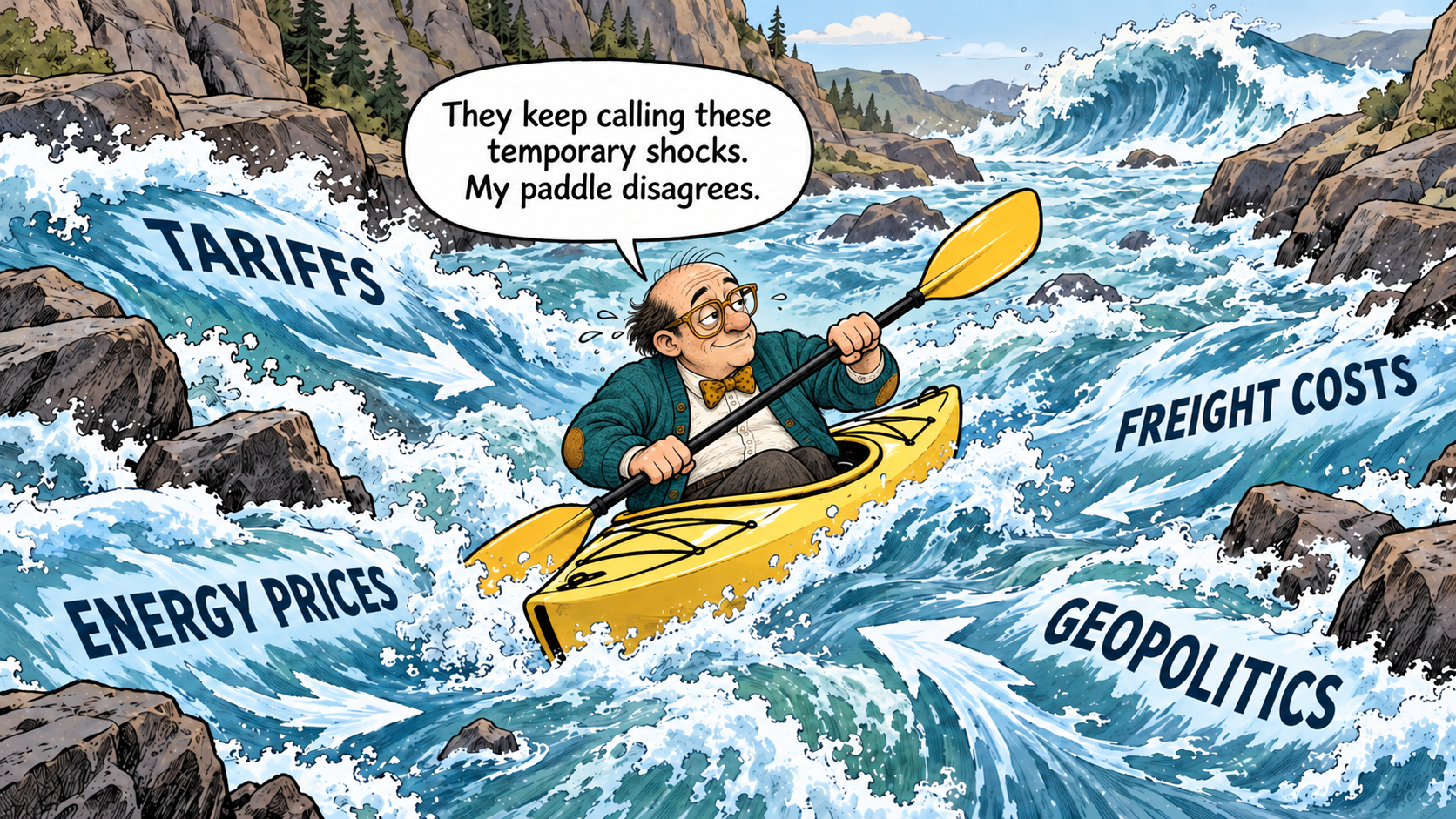
Some businesses are raising prices. Others are absorbing higher costs, hoping energy prices, tariffs and trade disruptions will eventually subside.
This sounds like a pricing problem.
It is actually a forecasting problem.
Every company that holds or changes its prices is making an implicit prediction about tariffs, energy, freight, geopolitics and consumer demand.
The problem is that companies are still treating disruption as an episodic event—something to absorb until conditions return to normal.
But the shocks are no longer episodic.
They are endemic.
The old pricing model assumed the storm would pass
Businesses have traditionally responded to cost shocks by waiting for conditions to normalize.
A tariff is announced. An important shipping route is disrupted. Energy prices spike. A raw-material supplier raises prices.
Management absorbs some of the increase, imposes a temporary surcharge or delays a permanent price increase because the disruption may be short-lived.
That approach works when shocks are isolated.
It breaks down when one disruption is immediately replaced by another.
A tariff is imposed and then challenged. An exemption expires. A government announces a new trade restriction. A shipping route closes. Energy prices rise. A supplier relocates production. A court overturns one tariff just as another geopolitical event changes the cost structure again.
Each individual wave may eventually recede.
But the next wave arrives before the water becomes calm.
Every price now contains a macroeconomic forecast
When a company absorbs higher costs instead of raising prices, management is implicitly forecasting that the disruption will be temporary.
When it raises prices immediately, it is forecasting that the pressure will persist—or that waiting will cause unacceptable margin damage.
Neither choice is safe.
Raise prices too aggressively and customers may reduce volume, delay purchases or move to a competitor just as the cost pressure begins to ease.
Wait too long and a supposedly temporary cost can consume months of margin that may never be recovered.
Companies are therefore being asked to set prices using assumptions about trade policy, court decisions, energy markets, shipping costs, interest rates and consumer resilience.
That is no longer traditional pricing.
It is macroeconomic forecasting disguised as a price list.
The steady-state low price may no longer exist
Businesses traditionally establish prices by estimating a normalized cost base, adding an appropriate margin and assuming that temporary volatility will eventually fade.
That model depends on the existence of a relatively stable destination—a steady state to which costs ultimately return.
But what if there is no steady state?
The economy may eventually adjust to any single disruption. Supply chains reroute. New suppliers emerge. Energy markets rebalance. Tariffs are absorbed, reversed or incorporated into contracts.
But businesses increasingly do not have time to reach that equilibrium before the next wave arrives.
That makes it nearly impossible to establish a durable “low price” based on normalized costs.
Any company pricing as though today's favorable conditions will persist risks locking itself into a price that cannot absorb tomorrow's disruption.
At the same time, permanently pricing for the worst-case scenario would make the company uncompetitive and unnecessarily burden customers.
The problem is not simply determining whether prices should be high or low.
The problem is trying to establish a fixed price in an environment that refuses to remain fixed.
Stop searching for the one correct price
In this environment, the objective should not be to discover one perfect price.
It should be to build a pricing structure that can survive when the forecast is wrong.
- A competitive base price with separately identified tariffs or surcharges
- Shorter quote-validity periods
- Tariff, freight and energy adjustment clauses
- Smaller and more frequent price changes
- Country-of-origin provisions in customer contracts
- Customer- and product-level margin analysis
- Clear triggers for repricing when costs move
- Faster measurement of volume and customer-retention effects
The price cannot be treated as a permanent destination.
It must become an adjustable mechanism.
The objective is no longer to predict the future perfectly. It is to shorten the time between a change in economic reality and the company's response.
The CFO questions
The wrong question is:
“How much should we raise prices?”
The better questions are:
“What are we assuming about how long this cost increase will last?”
“How much of our cost comes from the tariff itself, and how much comes from tariff uncertainty?”
“How long can we absorb the increase before waiting becomes more expensive than repricing?”
“What happens if the policy changes again?”
“Can our pricing structure adjust without reopening every customer agreement?”
These questions turn pricing from an occasional sales exercise into an ongoing risk-management and capital-allocation process.
The Bite-Sized Take
Companies keep searching for the low, normalized price they can confidently offer customers.
But that price assumes a stable world.
Tariffs, energy costs, freight disruptions and geopolitical conflicts now arrive in overlapping waves. One may recede, but another appears before businesses can reset their supply chains, inventory and pricing.
The individual shock may be temporary.
The waves of uncertainty are endemic.
In that environment, the winning company will not be the one that discovers the perfect steady-state price.
It will be the one that stops pretending such a price exists—and builds enough flexibility to remain competitive through whatever current comes next.