“Voluntary” reductions. An increasingly AI-shaped workforce.
Microsoft’s buyout offers, covered in this WSJ article, invite a broader question: how will companies organize work as AI becomes part of the workforce? An employee may choose whether to accept an offer; the organization is still making a deliberate choice about the workforce it wants.
Buyouts alone do not establish that an AI agent can replace each departing employee. But they make the debate about AI and organizational design more concrete.
A new workforce ratio
One observation in the article stood out. HR analyst Josh Bersin describes growing executive attention to “the ratio of employees to AI agents inside companies.”
That could become a defining workforce metric. Managers already discuss headcount, spans of control, and revenue per employee. The next discussion may include how many agents each employee can effectively direct.
The significance extends beyond a smaller payroll. A manager might coordinate people who exercise judgment alongside agents that prepare analyses, follow up on requests, or execute clearly defined tasks.
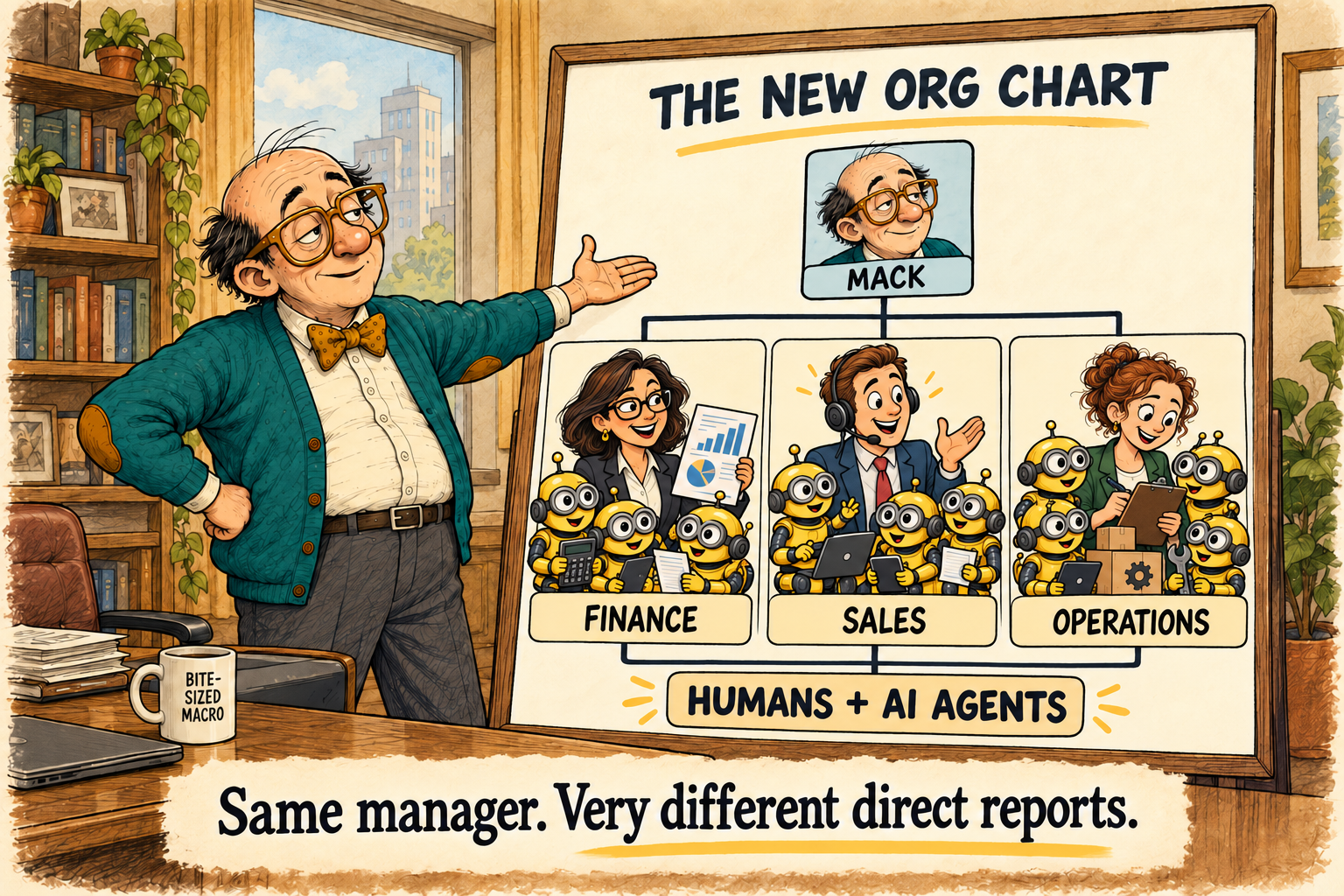
Same manager. Very different direct reports.
Mack’s new org chart has a familiar face at the top. Beneath him, Finance, Sales, and Operations each have one human leader working with a team of AI minions.
The cartoon makes the shift look simple. The management questions are harder. Who assigns the work? Who reviews it? Which decisions can an agent make independently, and which require a person’s approval?
An agent may also serve several departments or operate only for a particular project. A conventional reporting line may no longer describe how the work actually gets done.
The org chart may need to show both who owns the outcome and how people and agents deliver it.
The work between systems
Much of the opportunity lies in the work between systems: moving and reconciling data, updating Excel files, and sending routine requests for information. With appropriate permissions and validation, agents can perform these tasks while transactions continue through existing ERP approval workflows. People retain authority over approvals and responsibility for exceptions.
Agents can take on substantial execution work without receiving the same decision rights as their human colleagues.
Count the results, too
The employee-to-agent ratio can describe a changing workforce. It cannot, by itself, establish better performance.
Ten agents that create more review work may deliver less value than two that reliably complete a process. Agent costs, human oversight, errors, and exceptions all belong in the calculation.
For a CFO, the test is practical: does the combination improve output, speed, quality, and total cost? Revenue per employee may rise as headcount falls, while software and supervision costs absorb the apparent gain.
Longer term, competition will determine how much of any productivity gain becomes higher margins, lower prices, or additional output. A smaller workforce is only one possible result.
The manager’s job changes
If employees increasingly direct agents, management becomes more explicit about defining tasks, setting permissions, checking results, and handling exceptions.
The employee-to-agent ratio is an early signal of that organizational shift. The more consequential question is whether companies redesign the work and accountability around it.
Mack may need a bigger org chart even as his human headcount shrinks. His responsibility for the outcome stays with him.